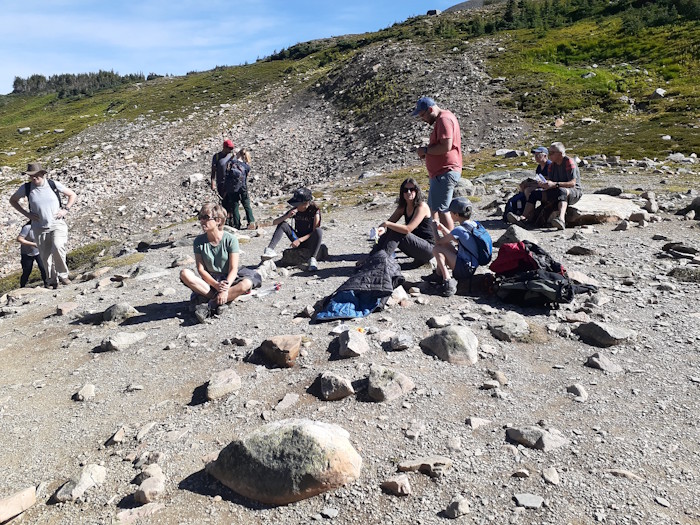
High on a mountain, after much prayer, weighed down with sleep, the disciples hallucinate. Or perhaps dream a dream, or see a vision, or experience the thinnest place on earth, where the invisible meets the visible, and the ethereal weaves itself into the corporeal and everything looks the way it actually is — somatic, sacred, all tangled together.
And Moses and Elijah appear in glory, and Jesus is glowing — transfigured. What do they discuss? His harrowing exit? Do they advise him? Moses, presumably, died of old age; Elijah was transported straight to paradise. How do they advise him, or do they make plans to meet over a wineskin after it’s all over? We’re left guessing.
In the meantime, the disciples are terrified, and they fall down in fear. Peter, beside himself, blurts out something that entirely misses the point. We recognize this. It’s the need to do something, say something, in the midst of being knocked on your ass. Here, amidst shock and awe, almost a moment of humour.
And then, tenderness: Jesus touches them, says, “Get up, be not afraid.” Words of assurance — his merciful habit.
Jesus then instructs the disciples to keep the whole episode to themselves. Wise advise. (Should you be one who has seen a UFO, I will advise you in like manner.)
No way around it: this is a story meant to confirm the glory and divinity of Jesus, and with Moses and Elijah in the mix — a story meant to demonstrate that Jesus is the fulfillment of the covenant, the law, the utterances of all the prophets, the whole wild cabaret that came before.
And while the face of Jesus is still beaming from the radiance within, the voice of God comes through a thick, bright cloud: “This is my Son, my Chosen, the Beloved, listen to him!”
But how do I listen? What should I listen for?
There’s a story relayed by Mary Gordon in her book, Reading Jesus, about a priest who cared for a man who was cognitively impaired. The priest once asked him, “Do you pray?” “Yes,” said the man. “How do you pray?” asked the priest. He said, “Oh, I listen.” “What do you hear?” asked the priest. The man said, “I hear, ‘you are my beloved!’”
I just want to catch my fish, drive my truck, drink my beer / And not wake up to all this stuff I don’t want to hear / Like the same kind of gun I hunt with / Just killed another man / Only thing mine ever shot was / Deer from my deer stand.
“I just want to cut my grass, feed my dogs, wear my boots / Not turn the TV on, sit and watch the evening news / Be told if I tell my own daughter that little boys ain’t little girls / I’d be up the creek in hot water in this cancel-your ass-world.
Chorus:
“It ain’t easy being country / In this country nowadays / The direction the finger’s pointing / When everything goes up in flames / Saying I’m some right-wing devil / Because I was down South Jesus raised / It ain’t easy being country / In this country nowadays.”
First of all, I’m deeply sorry if someone called you a right-wing devil. That’s not right. There’s nothing wrong with being raised in the South, hunting for your own food, or having small-town values and conservative roots — least of all being “Jesus raised.” Coming from a small prairie town in Saskatchewan, reared in a Baptist church, I’m familiar. But I won’t claim to have your experience, I’d just like to understand your grievances, I’d like to understand you.
You’re right about things going up in flames. Clearly, we stand at the threshold of chaos. I’m guessing, besides the injustice and injury you feel, you wrote the song out of a sense of losing things you hold dear, losing control of a way of life.
Well, let’s start there: we know country songs — among all the other things you’ve mentioned — like to talk about love. Love, after all, is what Jesus is about. He chose love over hatred. By the way, he would have applauded Bad Bunny’s banner, which said exactly that. And being Jesus-raised, I’m sure you’d agree.
And you’re right, Jesus (nor should those who follow him) wouldn’t have mocked you or derided you for being “country” or being raised down south. He was from Nazareth, for god’s sake, and “nothing good comes out of Nazareth” was a common refrain back then.
He wouldn’t have cancelled you, or questioned your desire for a good life, or the nostalgia, even romance, for a certain understanding of country. (Although, if you were comfortable, he may have wanted to get around to that.) He would have, however, asked you about your motive for appearing at an alternative, separate, segregating, “All-American” Halftime show (P.S. Puerto Rico has been a part of America for 127 years, and Puerto Ricans have had U.S. citizenship since 1917), and he’d have asked you about your lyrics. Not so much what they said, but what they implied, what they left out — being Jesus-raised, you’d have an inkling about why.
Without condemning any of your home-grown loves, he’d have counselled: Yes, catch your fish, and then, why not share them (multiply them); by all means, drive your truck, then, maybe go on a food drive; drink your beer, no worries, but drink also the “new wine” of gospel humility, charity; cut your grass, for sure, then help tend a community garden; feed your dog, absolutely, and feed the poor. I need to pause here, because I’m sure you’re not without charity; I’m sure you do some of the foregoing. I’m only going by your public song; it has discordant notes.
I’ll go on. Try on empathy. Despite the late Charlie Kirk’s (founder of Turning Point) distaste for that word, it is a Jesus-raised virtue. So wear your boots, but also, wear the bare feet of a Palestinian boy, the sandals of a black girl in inner-city Camden, New Jersey, the shoes of a Puerto Rican, maligned then ignored by a President, and the tear-stained slippers of the spouse of Renee Good.
As a parent, you have the responsibility to care for your children and teach them values and virtue — well, you know that — but what if your daughter came to you and said, “I don’t fit in, I don’t feel at all like other girls, I’ve felt for as long as I can recall, like a boy.” (I have firsthand experience here.) I know you wouldn’t shut her down; you’d want to have a loving, understanding conversation. And I guess that’s all I’m asking.
Do write your country songs, be blessed by your gift, but go back and brush up on being Jesus-raised. And don’t be too surprised at a bit of push-back by those who view your song as just another privileged claim of victimhood.
Me? I’m nothing much, just a Canadian watching, wanting and trying to love the people of my neighbouring country and trying dearly to honour the heart of my own Jesus-raised legacy. And not have it be someone’s justification for materialism, atheism, which frankly, in view of “God-fearing” nationalist Christian-ism, I wouldn’t blame anyone for considering.
There is news that will enrage your mind and raise your cortisol, leave you limp as a doll while you lower your face into your open hands; and everything within you calls you to retreat from the world, and you do, and it’s good, and the healing in that hour, steadies, readies you to reenter.
There are centering moments when Love floods and breaches the barriers of the mind, encompassing the body; and the body, with its demands, and betrayals, large and small, are suspended, then held, then released to the wash.
There are minutes that stretch to hours when Love drifts like the laziest river, and you in your canoe, overcome with an abundance of time, break free of your plans and rest in the light, kindness, and shade of your own heart. A Christic gift — so not of your own making — but of your availing.
There are horizons so vivid, so overwhelmingly blue, as to take your hand and walk you back into the world, so near as to arrest your weariness and awaken tenderness: a compassion for self, and compassion for others — two sides of the same manifestation.
There is a Love so embodied as to move you to ever-moving stillness, so connected as to dismantle any egoistic motive — which calls you to charity, for both neighbour and enemy. This fearless Love, that without hesitation yet aware of the cost, compels you to stand and call out the cruel rot of injustice.
Faith is about fanning the embers of a childlike perception.
The individual is a phantom; in wonder and blunder we receive our selves through the eyes of others. Meaning, dear reader, my personal fulfillment is in your flourishing.
The first half of life is spent anchoring ourselves; the second half is spent unmooring ourselves.
The heart is a spotted pear — there’s no getting through without some bruising.
The mind is a sea star — moving its brilliant purple rays in multidirectional ways, and clinging, so often, to the same facade.
The soul at peace is paradise.
Beneath the surface of an ordinary day lies an infinite wellspring of meaning — this untold depth is what many call God.
Should you want to find God, which is to say, should you desire meaning, learn to love the earth and her array of inhabitants.
There are 25 flowers that symbolize peace, but only the Brown-eyed Susan symbolizes justice. Tend all of them well.
Tempting, in this climate, to trade the callus-building requirements of reality for the passive comfort of hoping.
Our favoured assumptions and cherished certainties should routinely be set on fire to see what rises from the ashes.
A tincture of cynicism is emancipating, but a full meal is constipating.
To laugh at yourself is to deinstitutionalize your ego.
The crushed grapes of relinquishment can sometimes be Beaujolais for the soul.
Press your face against your keyboard, canvas, or soapstone, it will open a door.
What seemed unthinkable is now obvious — both science and religion are converging on the essential fire. It’s time they had a heart-to-heart.
Every birdcall beckons, “Unveil your hearts!” “All creation cries for love!” is every cricket’s song.
Of course, we are falling; let us pray for companionship in the descent.
Death and dying — hard, hard, hard — and any kind of bromide is unfitting.
To counsel hope can sometimes be malpractice; to discount hope is spiritual dereliction.
The twin sister of praise is grief.
Aging changes chores into privileges and anxieties into prayers.
Despite the crazed magnificence of our vanities, our deepest longing is to be each other’s joy.
The Big Bang is God’s dancing body. The shimmering fallout is yours.
Put-your-love-where-there-is-no-love-and-you-will-find-love — is the only religion worth practicing.
Heaven, if we have the eyes for it, is us, in our unfolding inclusiveness.
A flash of insight can skyrocket your life, but don’t go publish a creed.
A glib apology creates another wound; an honest one is ointment.
Friendship is a full-bodied Cabernet; an acquaintance is only the label.
Pavement, like a hard heart, longs to be pierced by grass.
A side dish of skepticism is good for you, but a main course will give you gas.
Truth languishes in the theatres of politics, flourishes in the cries of children.
God is a verb, Jesus, the expositive. God is haiku, Jesus is free verse.
It’s time to let chrysanthemums weigh in on climate change.
Don’t drag around what’s perished — everything you need you’ll find along the way.
Don’t vomit outright — let the poison pass through and teach you, what to hate, what to tolerate.
Theology says I come from the heavens, poetry says I come from Springside, Saskatchewan.
Fame is tinsel, intelligence is a window, kindness is a cathedral.
Gender is both river and riverbed, and as enigmatic.
Don’t scold yourself; worry is a form of prayer.
Faith is about fanning the embers of a childlike perception.
Distressingly, it’s taken me this long to see that my privilege is also my particular blindness.
A cultural obsession with sex is a sign of deep loneliness, lost intimacy.
We are lonely pilgrims, bottles in smoke — when finally our obsessions and addictions are spent — we discover that what is most alive is what we already had.
Beauty is a basket of grapes, happiness is champagne, and laughter the bubbles.
Poetry liberates paradox — reanimates a capacity for insight.
Art enlarges our being, cultivates imagination, which is why despots defund it.
Science and religion are humble in theory, but not when monetized.
Time is a tide that winds, folds, bends and swirls — vain to clutch it or try to stop it — but you already knew that.
Love, that embattled radiant thing — sometimes a gleaming gem, more often: arms that reach for us through the grief-fractured layers of our lives.
Our inner void — that canyon that yawns open when we’re alone and still — must not be skipped over, but leapt into.
You can love the earth and not love God, but you can’t love God without loving the earth.
Quantum entanglement may be one more name for God;
Snowflakes are the ghosts of fallen leaves.
Should you get anything absolutely right in life, it is critical you go back and correct it.
When we come into our beauty, we’ll admire acts of kindness over feats of cleverness.
To pray for the peace of our troubled world may or may not add a spark of hope to this flickering new year, but it’ll bolster your soul.
When we finally meet, I’m fine with a hug, if you are.
Wishing you a beautiful New Year with rivers of awe and eddies of joy!
A note: I’m not done yet, but over the coming months, I’ll be slowly retiring Grow Mercy. This Easter marks 20 years and some 1500 posts. And here, a deep bow to you, for reading and responding.
I’ll not, however, be retiring the impulse behind Grow Mercy, but will be shifting, exploring, following a hybridized urge, and a genre to suit. For me, what these decades have increasingly revealed is how writing is a spiritual path. Now, for whatever time and energy remains for me, I’ll be tilting more toward The Ragged Psalmist, still inchoate, but the handle feels like it fits. I do hope you’ll subscribe.